



The Forgotten Gateway to the Future
History : The Italian Dream, Reimagined in Detroit
In 1987, Lamborghini's ownership changed hands when Chrysler Corporation acquired the iconic Italian brand. Eager to showcase their new acquisition and exploresynergies between American engineering and Italian design, Chrysler set out to create a concept car that would reflect the vision of a future Lamborghini sedan.
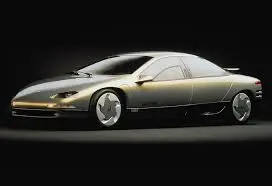
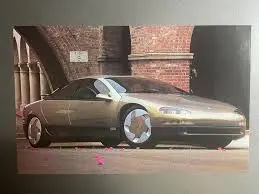
The result was the Lamborghini Portofino, a sleek four-door concept unveiled at the 1987 Frankfurt Motor Show.
Rather than building a car in Italy, the Portofino was developed entirely in the United States. Based on a lengthened version of the Jalpa chassis and powered by
the same mid-mounted 3.5L V8 engine, the Portofino was a radical reinterpretation of what a Lamborghini could be - practical, futuristic, and luxurious - yet unmistakably
exotic. It was also the first project assigned to the team at Chrysler's Pacifica design center, led by designer Kevin Verduyn.
Although the Portofino never went into production, it served as a stylistic and conceptual predecessor to the Chrysler LH platform of the early 1990s. More than just
a show car, the Portofino became a symbol of transatlantic ambition and design experimentation.
Design : A Wedge of the Future
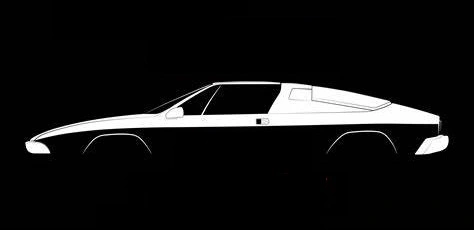
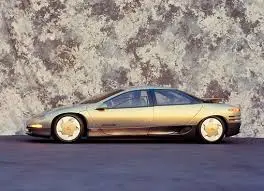
The Lamborghini Portofino was a bold leap into futuristic design language, marrying Italian exoticism with American practicality. Kevin Verduyn’s original concept, internallyknown as the Navajo, evolved into the Portofino under Lamborghini’s badge. Its body featured sharp angles, a long wheelbase, and a dramatically low roofline, an unmistakable
homage to the wedge-shaped supercars that defined Lamborghini’s earlier years.
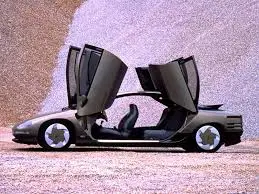
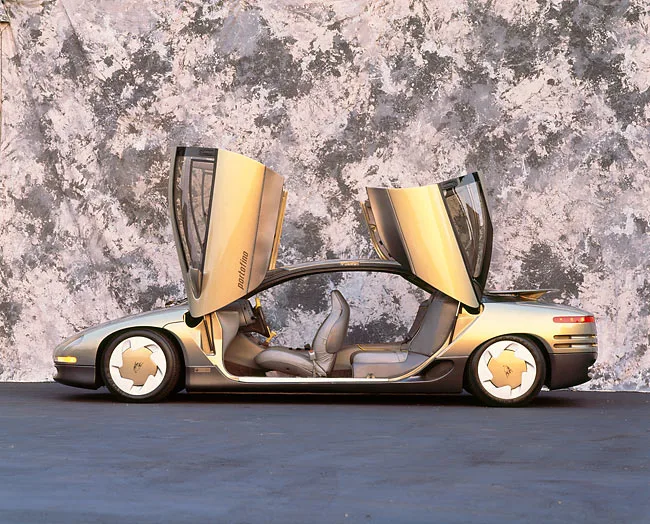
One of the most remarkable aspects of the Portofino was its unique four-door “scissor” configuration. All four doors opened upwards in dramatic fashion, an extension of the
iconic Countach-style doors, but applied to a sedan layout. The expansive glass canopy, minimal front and rear overhangs, and wide stance gave the Portofino a futuristic profile
unlike anything else on the road.
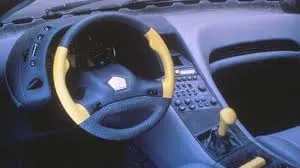
Inside, the cabin featured a wraparound dashboard, digital instrumentation, and seating for four, all enclosed in a cocoon of leather and innovation. The car’s interior blended
advanced tech with Chrysler's ergonomic understanding, offering a hint at what the luxury sports sedans of the 1990s might become. Even though it was never intended for mass
production, the Portofino’s design left a lasting impression. Its DNA could later be seen in models like the Dodge Intrepid and Eagle Vision.
Driving Experience : A Concept in Motion
While the Lamborghini Portofino was primarily a design study and showpiece, it was far more than a static model. Unlike many concept cars of its era, the Portofino was fullyfunctional and capable of being driven. Underneath its futuristic skin lay a modified version of the Jalpa’s mechanical setup, including the mid-mounted 3.5L V8 engine paired
with a 5-speed manual transmission.
Performance was not its primary goal, refinement and vision were. Yet, the Portofino still delivered a spirited drive. The V8 engine provided ample power to move the extended
chassis with confidence, and the low-slung seating position maintained a sense of Lamborghini theater. With its wide stance and mid-engine balance, the car handled with surprising
composure for a sedan-shaped prototype.
However, due to its one-off nature and experimental construction, the Portofino was rarely tested on public roads. Most of its movement was limited to press events and controlled
environments. Its value was less about raw speed and more about demonstrating that radical design could be brought to life without sacrificing usability.
Fun Facts : One Car, Many Influences
- The Lamborghini Portofino was based on a stretched Lamborghini Jalpa chassis, which explains its unusual mid-engine, rear-wheel-drive layout for a four-door car.
- All four doors opened vertically in scissor style, a world first for a sedan. This dramatic touch paid tribute to the Countach and pushed the boundaries of concept car theatrics.
- The design started life not as a Lamborghini but as the Chrysler Navajo, a futuristic four-door concept drawn up at Chrysler’s Pacifica Advanced Design Studio.
- Although the Portofino remained a one-off, its design DNA directly inspired the Chrysler LH platform. The 1993 Dodge Intrepid, Chrysler Concorde, and Eagle Vision all bear clear
visual cues from the Portofino, especially in their cab-forward proportions. - After its world premiere at the 1987 Frankfurt Motor Show, the Portofino toured the global auto show circuit and was even driven briefly for press demonstrations.
- The original Portofino was nearly lost to history. Tt suffered a fire during transport but was later restored by Chrysler and preserved as a design icon.
- It was also featured in the "Detroit Style: Car Design in the Motor City, 1950–2020" exhibit at the Detroit Institute of Arts from November 15, 2020, to January 9, 2022.
- The Portofino prototype is currently on display at Chrysler’s headquarters in Auburn Hills, Michigan.
Legacy : The Lambo That Shaped Chrysler
Though it wore a raging bull on its nose, the Lamborghini Portofino’s legacy belongs as much to Detroit as it does to Sant’Agata. It never reached production, but its influencerippled far beyond the concept stage. The Portofino became the visual blueprint for Chrysler’s radical “cab-forward” design strategy, which defined the company’s sedans throughout
the 1990s and early 2000s.
For Lamborghini, the Portofino stood as a symbol of experimentation, proof that the brand could stretch beyond mid-engine supercars and embrace other formats without losing its
identity. It hinted at the idea of a Lamborghini sedan decades before the Estoque concept or the production Urus SUV.
For Chrysler, it was a design breakthrough. The Portofino proved that bold aesthetics, interior space, and aerodynamic efficiency could coexist. It was a show of confidence at
a time when Chrysler sought to reinvent itself.
Today, the Lamborghini Portofino remains a fascinating time capsule: a car born from a unique moment in automotive history, when American ambition met Italian flair. It may not
have been a commercial product, but its legacy lives on in both brands’ evolution.

Specifications
| Category | |
|---|---|
| Prototype Year | 1987 |
| Build | 1 concept car (fully functional) |
| Designer | Kevin Verduyn (Chrysler Pacifica Studio) |
| Engine | 3.5L V8 DOHC (Jalpa-based) |
| Power Output | 255 hp (190 kW) @ 7,000 rpm |
| Torque | 305 Nm (225 lb·ft) @ 3,500 rpm |
| Top Speed | Estimated 240 km/h (149 mph) |
| Transmission | 5-speed manual |
| Drivetrain | Rear-wheel drive |
| Length | 4,870 mm (191.7 in) |
| Width | 1,980 mm (77.9 in) |
| Height | 1,140 mm (44.9 in) |
| Wheelbase | 2,820 mm (111.0 in) |
| Weight | Approx. 1,400 kg (3,086 lbs) |
| Fuel Capacity | 82 L (21.7 US gal) |
| Wheels | Unique Portofino-specific alloy wheels |
| Front Tires | 225/50 R15 |
| Rear Tires | 285/40 R15 |
| Tire Brand | Pirelli P7 |
| Chassis | Stretched Lamborghini Jalpa platform |
| Suspension Front | Independent suspension |
| Suspension Rear | Independent suspension |
| Brakes | Ventilated disc brakes front and rear |