



The V12 MPV That Never Was
History: When the Raging Bull Tried to Carry a Family
In 1988, Lamborghini and Bertone joined forces for one of the most audacious experiments in automotive history. The result was the Genesis, a one-off luxury minivanpowered by a V12 engine. At a time when Lamborghini was synonymous with low-slung supercars and aggressive styling, the Genesis stood apart as a futuristic people
carrier that dared to ask: what if practicality could wear a Lamborghini badge?
Developed under Chrysler ownership, the Genesis was never intended for production. Instead, it served as a rolling concept that blurred the lines between performance
and utility, luxury and experimentation. This was not just a van, it was a radical vision of what Lamborghini could be, had it ever chosen to trade racetracks for school runs.
Design: Wedge Meets Wagon
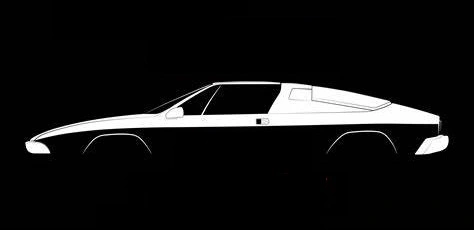
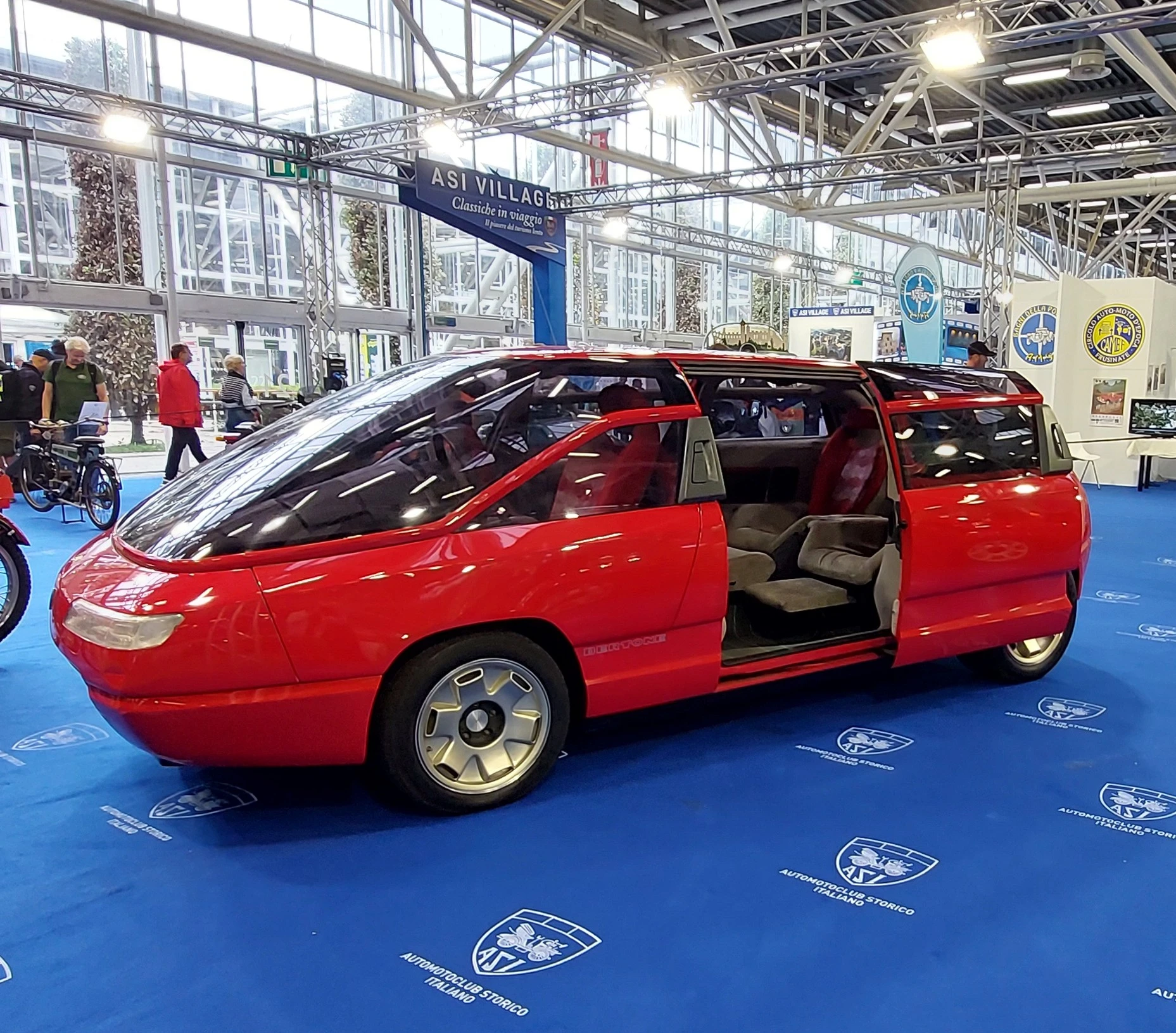
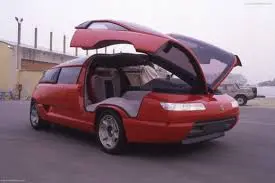
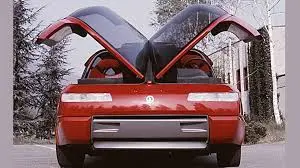
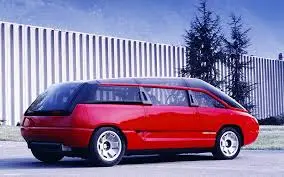
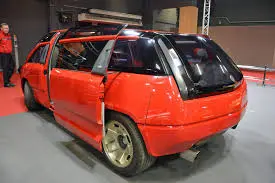
Designed by Bertone, the Genesis was unlike anything else on the road. Its dramatic wedge-shaped profile, sharp creases, and expansive glass surfaces gave it a space-agesilhouette. A full wraparound windshield met sculpted flanks and wide rear haunches, combining minivan proportions with unmistakable Italian flair.
What truly set the Genesis apart was its door configuration: gullwing-style openings at the front and sliding doors at the rear, with no central pillars to get in the way.
The result was not just practicality, but drama, passengers stepped in, not climbed aboard.
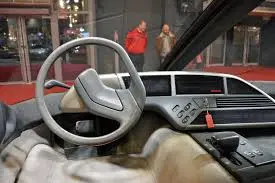
Inside, it offered lounge-like comfort for six, with individual leather seats, digital readouts, and a refined cabin layout that was more first-class cabin than family transport.
It was a luxurious vision of movement, designed to carry people with the same presence as a Countach carried speed.
Driving Experience: A V12 Beneath the Surface
Underneath its unconventional body, the Genesis was pure Lamborghini. It borrowed the 5.2-liter V12 from the Countach Quattrovalvole, producing 455 hp and sending it to the rearheels. The engine sat in a mid-rear position, a bold layout for such a large vehicle, but a decision that aligned with Lamborghini’s performance DNA.
Instead of a manual gearbox, a three-speed automatic transmission was fitted, aimed more at comfort than lap times. No official performance figures were ever released, but with
that much power and a relatively lightweight design, the Genesis was certainly no slouch.
Though it never roared on public roads, it proved that even a minivan could carry the soul of a supercar — at least when Lamborghini was behind the wheel.
Fun Facts: One Van to Rule Them All
- The Genesis is the only MPV ever built by Lamborghini, a true one-off with no successors.
- Its engine came straight from the legendary Countach: a 5.2L V12 with 455 horsepower.
- The gullwing-style front doors and rear sliders created one of the most dramatic entry experiences ever in a van.
- It featured a mid-engine layout, an extremely rare configuration for a six-seater vehicle.
- The Genesis interior featured six individual seats, each luxuriously finished and independently adjustable.
- Its design influenced several later Bertone studies and left a subtle mark on future MPVs and crossovers.
Legacy: A Glimpse of the Road Not Taken
The Lamborghini Genesis remains one of the most unexpected creations in the brand’s history. It didn’t lead to a production model, nor did it spawn a new segment for the company. Butit left a lasting impression, a symbol of how far Lamborghini’s creativity could stretch when freed from convention.
Today, the Genesis lives on in Bertone’s historic collection, appearing occasionally at exhibitions to remind enthusiasts that sometimes the boldest ideas are the ones that don’t get
built. It’s a vehicle that challenges expectations, standing proudly as proof that the raging bull was never afraid to charge into the unknown.
Remark
The top picture is taken at Auto Moto d'EPOCA Bologna 2024.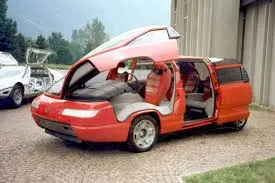
Specifications
| Category | |
|---|---|
| Prototype Year | 1988 |
| Build | 1 prototype (fully functional) |
| Designer | Marc Deschamps (Bertone) |
| Engine | 5.2L V12 DOHC (Countach Quattrovalvole) |
| Power Output | 455 hp (339 kW) @ 7,000 rpm |
| Torque | 500 Nm (369 lb·ft) @ 5,200 rpm |
| Top Speed | Estimated 250 km/h (155 mph) |
| Transmission | 3-speed automatic |
| Drivetrain | Rear-wheel drive |
| Length | 4,990 mm (196.5 in) |
| Width | 2,020 mm (79.5 in) |
| Height | 1,550 mm (61.0 in) |
| Wheelbase | 3,000 mm (118.1 in) |
| Weight | Approx. 1,800 kg (3,968 lbs) |
| Fuel Capacity | 90 L (23.8 US gal) |
| Wheels | 5-spoke alloy wheels |
| Front Tires | 245/50 VR17 |
| Rear Tires | 275/50 VR17 |
| Tire Brand | Pirelli P Zero |
| Chassis | Steel spaceframe |
| Suspension Front | Independent double wishbone |
| Suspension Rear | Independent double wishbone |
| Brakes | Ventilated disc brakes front and rear |