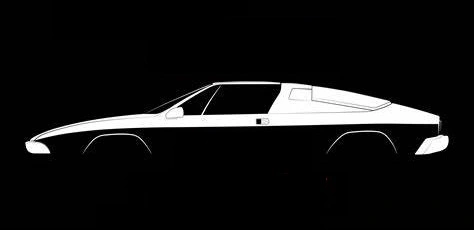




The Wedge That Shattered the World
History : The Birth of a Legend
Few names in automotive history carry the same electric charge as Countach. Uttered for the first time not in a boardroom or marketing meeting, but inpure astonishment by a Piedmontese factory worker, it’s an expression of disbelief, awe, and maybe a little fear. And rightly so: the Lamborghini Countach
didn’t just succeed the Miura, it redefined what a supercar could be. Aggressive, angular, unapologetic. This was the future, and it came from Sant’Agata Bolognese.
After the immense success of the Miura, Lamborghini needed something revolutionary. Not just a successor, but a shockwave.
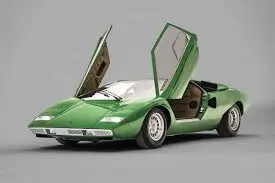
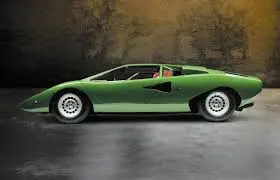
Enter Marcello Gandini of Bertone, the same design genius behind the Miura. But this time, he threw out the playbook. The LP500 prototype stunned audiences at the
1971 Geneva Motor Show with its razor-sharp lines, scissor doors, and cab-forward layout. It looked like a spaceship had crash-landed in Italy. By 1974, the first
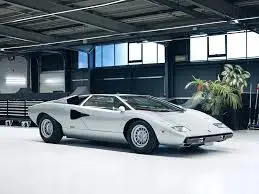
production version — the Countach LP400 — was ready, still futuristic but now with a 4.0L V12 instead of the prototype’s 5.0L.
The Countach would go on to be produced until 1990, and during those 16 years, it transformed both visually and mechanically. What started as a clean, low-slung
wedge gradually evolved into the wide-body, winged beast plastered on bedroom walls across the globe.
Design : Shaping the Wedge of Dreams
To speak of the Countach is to speak of a dream given form, an audacious vision sculpted not with caution, but with passion. From the moment Marcello Gandini’s pendanced across the page at Bertone, a revolution was set in motion. The Countach did not evolve from tradition; it shattered it, leaving behind the soft curves of the
past in favor of razor-sharp lines and impossibly low proportions. It looked less like a car and more like a spaceship that had fallen from a fevered imagination.
Every surface was deliberate, every angle a declaration. The wedge shape iconic, defiant spoke of speed even at a standstill, while the scissor doors, opening skyward,
became a symbol of futuristic elegance and mechanical theatre. The cabin, cocooned in leather and drama, invited the driver into an almost otherworldly embrace, where
sightlines were sacrificed in favor of seduction.
It wasn’t merely designed, it was conjured. The Countach whispered to the bold, called to those who desired not just to drive, but to make an entrance. It was a poster
on a million bedroom walls and a statement in every mirror it passed. A machine, yes, but above all, a masterpiece of desire and defiance, born not from necessity,
but from the sheer will to astonish.
Here’s a tribute to the designers who crafted the Countach legacy.
Marcello Gandini – The Visionary
Design house: Gruppo Bertone
Countach contributions: LP500 Prototype, LP400, LP400 S
Marcello Gandini, the same genius behind the Miura, broke every design convention of the early '70s when he sketched the original Countach. With its ultra-low wedge shape,
sharp creases, and iconic scissor doors, the Countach LP500 prototype stunned Geneva in 1971 like a spaceship landing in a sea of sedans.
Gandini continued his magic with the production LP400, maintaining the purity of his original concept. He also influenced the LP400 S, though the dramatic flares and wing
additions were functional updates made later by Lamborghini’s in-house team. Still, every version carried the unmistakable DNA of Gandini’s revolutionary pen.
“The Countach was never about beauty. It was about impact. You see it once, you remember it forever.” — Marcello Gandini
Lamborghini In-House Design Team – The Evolvers
Countach contributions: LP500 S, 5000 Quattrovalvole
As the Countach evolved into a more powerful and dramatic machine, Lamborghini’s internal team took over updates, focusing on functionality and performance. The LP500 S
added displacement but kept Gandini’s lines intact. Later, the 5000 Quattrovalvole required design tweaks like a taller engine cover and integrated intake systems due
to the massive Weber carburetors.
These versions kept the spirit alive, even as the silhouette became more aggressive and muscular.
Horacio Pagani – The Finisher
Role: Engineer & aerodynamicist at Lamborghini
Countach contribution: 25th Anniversary Edition (1988–1990)
Before founding Pagani Automobili, a young Horacio Pagani was entrusted with refining the Countach for its final chapter: the 25th Anniversary edition. His task? Improve
cooling, stability, and ergonomics without losing the soul.
Pagani subtly reshaped the bumpers, side skirts, and intakes for better airflow and downforce. The result was a Countach that looked more modern, more sculpted and more
ferocious than ever.
“It was my honor to close the chapter of the Countach. We treated it with reverence, like restoring a masterpiece for its final show.” — Horacio Pagani
Driving Experience : Driving the Dream (and the Nightmare)
Driving a Countach is not a casual affair. The seating is low, the clutch is heavy, the view out the back is almost nonexistent. And yet, that’s exactly the charm.It demands respect. The engine roars just behind your head, raw, mechanical, and full of rage. The gated shifter clicks with mechanical precision, the V12 sings
past 7,000 RPM, and the road feels alive beneath you.
And yes, parking it requires the classic "Countach reverse"—door open, perched on the sill. Theatric? Absolutely. But this car was born for the spotlight.
Fun Facts : Outrageous Truths
The word Countach is a Piedmontese exclamation, roughly translating to "Wow!" or “Holy smokes!” It wasn’t intended as the car’s name… until it stuck.The scissor doors became a Lamborghini signature thanks to the Countach, originally designed to help drivers navigate tight spaces in the wide-bodied machine.
Rear visibility? Let’s just say reversing requires faith and flair. Hence the legendary technique of sitting on the sill with the door open.
The rear wing, iconic as it is, was optional and actually reduced top speed due to added drag. Still, most buyers insisted on it because… well, just look at it.
Despite its dramatic evolution, the Countach remained true to its DNA: a naturally aspirated V12 and rear-wheel drive, with no compromises made for comfort.
Countach in Pop Culture : Wedge of Fame
From cinema to posters, video games to rap lyrics, the Lamborghini Countach wasn't just a car, it was iconography. With its outrageous design and unapologeticpresence, it naturally found its way into pop culture, becoming a universal symbol of speed, excess, and desire.
The Cannonball Run (1981)
A black LP400 S tears through the opening of The Cannonball Run. Outfitted with a front spoiler and twelve exhaust pipes, the car didn’t just steal the show, it
was the show. It even made use of its scissor doors during a police chase, forever etching the Countach into car movie history.
That car became a cult icon in its own right and may have single-handedly launched the Countach onto every teenage wall of the '80s.
The Wolf of Wall Street (2013)
Leonardo DiCaprio’s white 25th Anniversary Countach meets a less-than-glamorous fate in this wild film. Two identical cars were used, one for driving, one for
the now-infamous crash driving. Both were auctioned in 2024, one preserved and one still battered from its Hollywood moment.
Poster King of the 1980s
Walk into any teenage bedroom in the '80s, and chances are you'd see two things: Farrah Fawcett... and a white or red Countach with a massive rear wing. It became
the poster car of a generation.
In the Driver’s Seat
The Countach has appeared in countless games : Out Run, Gran Turismo, Forza Horizon, Need for Speed—forever linked to digital adrenaline and dream garage fantasies.
A Rap and Rock Icon
Shouted out in songs, idolized by rock stars. Billy Idol owned one, and rappers from Kanye to Travis Scott have name-dropped it. It’s more than a car. It’s a statement.
Celeb Status
Rod Stewart, Nicolas Cage, and a host of other celebrities couldn’t resist the Countach’s exotic pull. It’s the kind of car that doesn’t blend in, because it was never meant to.
Versions Through the Years
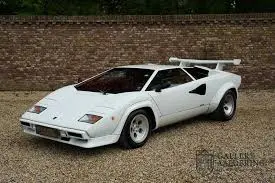
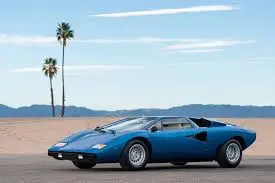
LP400 (1974–1978)The purist’s Countach. Clean lines, no spoilers, and a 375 hp 4.0L V12. The lightest and most elegant version, now the most sought-after.
LP400 S (1978–1982)
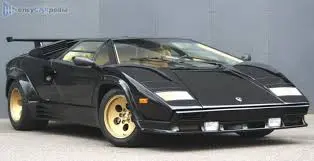
Added flared wheel arches, Pirelli P7 tires, and optional rear wing. More aggressive, lower ride height, but actually a bit slower than the LP400 due to added weight.
LP500 S (1982–1985)
Upped the displacement to 4.8L. Still carbureted, still angry. This version found a balance between drama and usability (well, Lamborghini's version of "usable").
LP5000 Quattrovalvole (1985–1988)
5.2L V12 with four valves per cylinder—hence "Quattrovalvole." Horsepower jumped to 455 hp, and the car gained even more muscle visually.
25th Anniversary Edition (1988–1990)
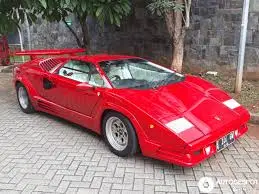
Restyled by Horacio Pagani, this was the most refined Countach ever. It had better cooling, more creature comforts, and arguably the most extreme styling of them all.
A love-it-or-hate-it finale.
Legacy : Forever Bold
The legacy of the Countach is not measured in numbers or lap times, but in gasps, in wide eyes, in hearts that raced before the engine ever turned. It is the car that redefinedwhat a supercar could be, not just a machine of performance, but an icon of untamed imagination. The Countach didn’t follow trends; it was a rebellion on wheels. It rewrote the
rules, shocked the establishment. Its silhouette burning itself into the collective memory of an era that dared to dream in color, noise, and speed.
When it arrived, it was as if the future had come early. No one had seen anything like it, and decades later, nothing has quite matched its impact. It inspired generations of
designers, pushed engineers to chase bolder visions, and taught the world that emotion could be engineered. Children pointed at it in awe; adults stared in disbelief. It made
the impossible seem suddenly, achingly real.
Even as time moved forward, the Countach remained frozen in its own myth, untouchable, unforgettable. Its echoes can still be heard in every Lamborghini that followed, a roaring
heartbeat from the past that still pulses in the present. The Countach was not just a car. It was an awakening. And in the golden light of automotive history, it stands eternal,
an impossible dream that somehow came true.
Even Lamborghini knew they couldn't leave the name buried. In 2021, they released the Countach LPI 800-4, a futuristic homage powered by a hybrid V12. A tribute not just to a car,
but to a revolution.
The Countach didn’t just dominate the roads.
It owned the culture.
Specifications
| Category | |
|---|---|
| Production | LP400 : 1974 - 1978 LP400 S : 1978 - 1982 LP500 S : 1982 - 1985 5000 Quattrovalvole : 1985 - 1988 25th Anniversary : 1988 - 1990 |
| Build | LP400 : 158 units LP400 S : 237 units LP500 S : 321 units 5000 Quattrovalvole : 610 units 25th Anniversary : 657 units |
| Designer | Marcello Gandini in house engineers for updates Horacio Pagani for the 25th Anniversary |
| Engine | LP400 : 3.9 L (3929 cc) V12, DOHC LP400 S : 3.9 L (3929 cc) V12, DOHC LP500 S : 4.8 L (4754 cc) V12, DOHC 5000 Quattrovalvole : 5.2 L (5167 cc) V12, DOHC, 4 valves/cyl 25th Anniversary : 5.2 L (5167 cc) V12, DOHC, 4 valves/cyl |
| Power Output | LP400 : 375 hp (276 kW) @ 8,000 rpm LP400 S : 353 hp (265 kW) LP500 S : 375 hp (276 kW) 5000 Quattrovalvole : 455 hp (339 kW)(EU) - 420 hp (USA) 25th Anniversary : 455 hp (339 kW) |
| Torque | LP400 : 361 Nm (266 lb-ft) @ 5,000 rpm LP400 S : 361 Nm (266 lb-ft) LP500 S : 414 Nm (305 lb-ft) 5000 Quattrovalvole : 500 Nm (369 lb-ft) 25th Anniversary : 500 Nm (369 lb-ft) |
| Transmission | 5-speed manual |
| Drive Type | Rear wheel drive (RWD) |
| Acceleration (0-100 km/h / 0-62 mph) | LP400 : ~5.4 seconds LP400 S : ~5.6 seconds LP500 S : ~5.4 seconds 5000 Quattrovalvole : ~4.9 seconds 25th Anniversary : ~4.7 seconds |
| Top Speed | LP400 : 315 km/h (196 mph) LP400 S : 293 km/h (182 mph) LP500 S : 293 km/h (182 mph) 5000 Quattrovalvole : 295 km/h (183 mph) 25th Anniversary : 295 km/h (183 mph) |
| Length | 4140 mm (163 in) 5000 Quattrovalvole Length 4145 mm (163.2 in) |
| Width | LP400 : 1890 mm (74.4 in) Others : 2000 mm (78.7 in) |
| Height | 1070 mm (42.1 in) |
| Wheelbase | 2450 mm (96.5 in) |
| Weight | LP400 : 1065 kg (2348 lbs) LP400 S : 1200 kg (2645 lbs)br>LP500 S : 1400 kg (3086 lbs) 5000 Quattrovalvole : 1490 kg (3285 lbs) 25th Anniversary : 1490 kg (3285 lbs) |
| Fuel Capacity | 120 L (31.7 US gal) |
| Wheel Type | LP400 : Campagnolo alloy LP 400 S : Campagnolo "telephone dial" alloy LP 500 S : Campagnolo alloy 5000 Quattrovalvole : OZ or Campagnolo alloy 25th Anniversary : OZ Racing alloy |
| Front and rear tires | LP400 : 205/70 VR14 (front) - 215/70 VR14 (rear) LP400 S : 205/50 VR15 (front) - 345/35 VR15 (rear) LP500 S : 225/50 VR15 (front) - 345/35 VR15 (rear) 5000 Quattrovalvole : 225/50 VR15 (front) - 345/35 VR15 (rear) 25th Anniversary : 225/50 VR15 (front) - 345/35 VR15 (rear) |
| Tires | LP400 : Michelin XWX LP400 S : Pirelli P7 LP500 S : Pirelli P7 5000 Quattrovalvole : Pirelli P7 25th Anniversary : Pirelli P7 |
| Chassis | Tubular spaceframe with aluminum panels |
| Front Suspension | Independent double wishbones |
| Rear Suspension | Independent double wishbones |
| Brakes | Ventilated disc brakes (all-around) |