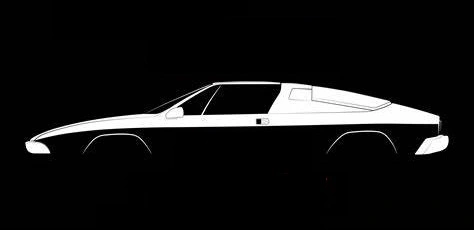




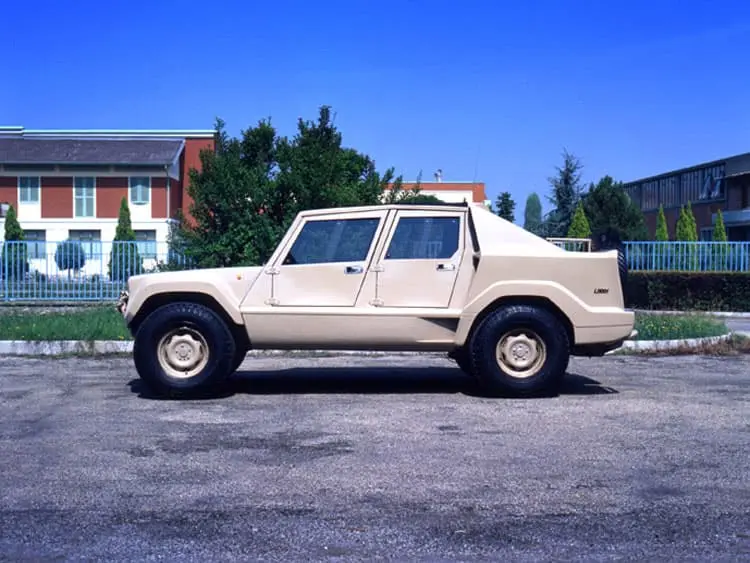
The Missing Link Between the Cheetah and the Legendary LM002
History : From Desert Dreams to Development Detours
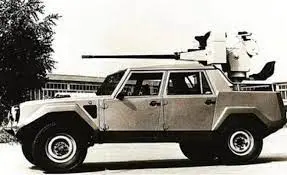
Following the failed military aspirations of the Lamborghini Cheetah, the LM001 emerged in 1981 as the company’s second attempt at entering the world of off-road utility vehicles.Like its predecessor, the LM001 was developed in response to the increasing demand for high mobility military grade machines. This time, Lamborghini pursued the project independently,
without the American partner Mobility Technology International (MTI).
Learning from the Cheetah’s design flaws, Lamborghini kept the rear-engine layout but switched to a different powerplant—an AMC-sourced V8. The LM001 was intended as a testbed for
further development, and only a single prototype was built. Despite efforts to improve off-road handling and reliability, the fundamental issue of weight distribution remained.
The rear-mounted engine still caused serious balance and control problems in rugged terrain.
Ultimately, the LM001 did not progress beyond the prototype stage. However, it played a vital transitional role in Lamborghini’s off-road ambitions, leading to a pivotal design
shift: relocating the engine to the front. This change would culminate in the development of the LMA002 and the production-ready LM002.
Design : Sharpening the Silhouette
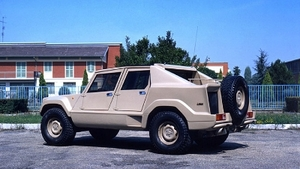
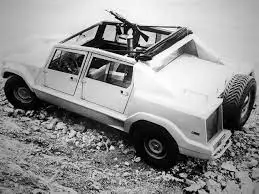
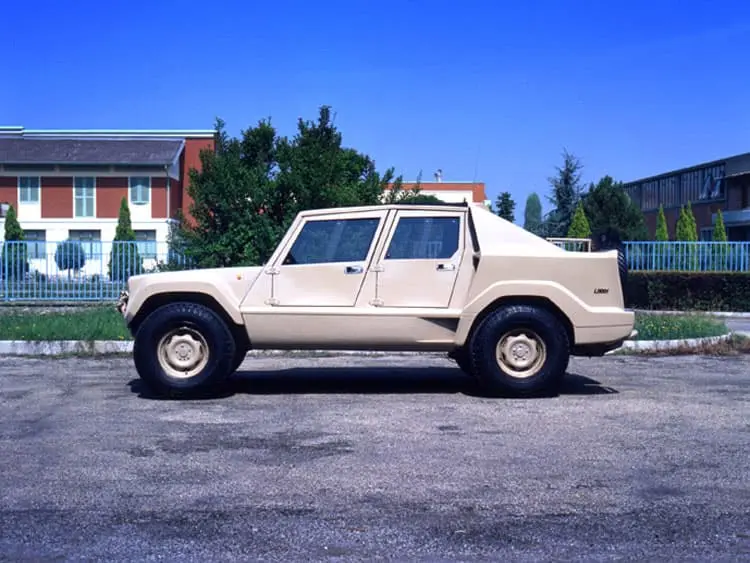
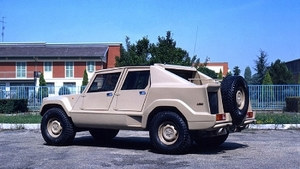
Visually, the LM001 retained the aggressive, utilitarian form factor introduced by the Cheetah. Its angular, boxy body was constructed to suit both military and civilian needs. Functionalrather than elegant, the LM001 featured flat surfaces, a high ride height, and large off-road tires that could take on punishing environments.
It was less of a design revolution and more of a structural refinement. Internally, the LM001 had a spartan cabin with minimal creature comforts—emphasizing practicality over luxury. Though
styled with rugged simplicity, the LM001 carried subtle Lamborghini design cues in its proportions and stance, hinting at the flair the brand would later bring to the LM002.
Driving Experience : A New Engine, Same Old Problem
While the switch from a Chrysler to an AMC V8 engine brought more reliability and domestic compatibility for potential military clients, the rear-mounted configuration again proved to bea critical flaw. The LM001's rear-biased weight distribution made handling precarious, especially on uneven terrain or during tight maneuvering.
The automatic transmission offered ease of use, but the vehicle’s dynamics remained difficult to master. Its off-road capabilities were better than the Cheetah’s, yet not good enough to
win military contracts or justify further investment without significant redesign.
Fun Facts
- Only one LM001 was ever built, making it one of the rarest Lamborghini models in existence.
- The LM001 marked the final time Lamborghini experimented with a rear-mounted engine in an off-road vehicle.
- The model served primarily as an engineering prototype, never intended for mass production.
- Despite its flaws, the LM001 laid the groundwork for the successful LM002 by highlighting the necessity of a front-engine layout.
Legacy
The LM001 may have been a commercial dead-end, but it was crucial in Lamborghini’s journey to creating a legitimate off-road machine. By revealing the inherent flaws in the rear-engine setup,it prompted Lamborghini’s designers and engineers to completely rethink their approach. The lessons learned from the LM001 directly led to the LMA002, which ultimately became the LM002—a vehicle
that would gain cult status as the “Rambo Lambo.”
As a prototype, the LM001 exists more in engineering lore than in the public eye, but its influence is undeniable. It represents the trial-and-error phase that many great innovations require,
especially for a brand boldly stepping outside its traditional domain.
LM Series Explained: The Confusing Model Numbers
Lamborghini’s LM series can be confusing, as the numbering doesn’t follow a simple pattern. Here’s a quick breakdown:- Cheetah (1977) – The original off-road concept, developed for the U.S. military with a rear-mounted Chrysler V8. It failed, and the prototype was destroyed.
- LM001 (1981) – A revised version with a rear-mounted AMC V8, but handling issues led to its cancellation.
- LMA002 (1982) – The first LM with a front-mounted engine (a Countach V12), serving as the real foundation for the LM002.
- LM003 Diesel (1983, prototype only) – A one-off test vehicle with a VM Motori diesel engine, quickly abandoned due to poor performance.
- LM004 (1983, prototype only) – A special version with an even bigger 7.2L V12 from powerboats. Only one was made.
- LM002 (1986-1993) – The production model with a Countach V12, becoming the legendary "Rambo Lambo."
- LM003 Borneo (1996) - Prototype by MegaTech.
Specifications
| Category | |
|---|---|
| Production | 1981 - Geneva Motor Show |
| Build | 1 unit |
| Designer | Lamborghini / internal engineering team |
| Engine | 5.9L V8 from AMC (American Motors Corporation) |
| Power Output | Approximately 180 hp (134 kW) |
| Torque | Not officially documented |
| Transmission | 3-speed automatic |
| Drive Type | Rear wheel drive (RWD) |
| Acceleration (0-100 km/h / 0-62 mph) | Not available |
| Top Speed | Estimated 160 km/h (99 mph) |
| Length | 4870 mm (191.7 in) |
| Width | 2000 mm (78.7 in) |
| Height | 1676 mm (66 in) |
| Wheelbase | 2990 mm (117.7 in) |
| Weight | 2042 kg (4500 lbs) |
| Fuel Capacity | Not documented |
| Wheel Type | Steel off-road wheels |
| Front and rear tires | Off-road military-spec tires |
| Tires | Not specified |
| Chassis | Steel tubular frame |
| Front Suspension | Independent, coil springs |
| Rear Suspension | Independent, coil springs |
| Brakes | Disc brakes (front and rear) |